Photographer's Statement
"This unintentional and mostly unnoticed renewal of the rural and mountainous east-not the spotted owl, not the salvation of Alaska's pristine ranges represents the great environmental story of the United States, and in some ways of the whole world." -Bill McKibben, 1995, from Foster, D.R. Forests in Time, p.vi
These woods are my home. I walk every day along the logging roads and deer runs in this second growth forest. I work to keep the photographs straightforward, specific and unromantic - just recorded moments from the lives of the trees. The beauty we experience arises from our deep connection to this world. We are of these forests and our urbanity rests upon them. These trees produce oxygen, paper, building materials and fuel. They retain rainfall reducing both floods and droughts. They provide clean watersheds, prevent erosion, moderate the climate, recycle nutrients, store carbon and are home to animals. But these landscapes are provisional. They are managed, working timberlands - private, state and national. Most of this productive forest was farmland; all of it has been logged repeatedly.
With the demise of the Vermont hill farms in the late 19th century, the forest reasserted its presence on the land. In 1870 forest covered 30% of the state; today 80% is woodland. This remarkable turnaround has taken place on what is overwhelmingly private land. In what might be seen as a longer agricultural cycle, most forests are logged on a regular basis. Which is not to say they are unsightly or provide impoverished habitat. Intensive management is not required to produce valuable timber for harvest in the naturally vigorous conditions of the Northeast. Vigilance is necessary though. Just recently forest acreage has begun decreasing in every state in New England. Only 18% of the forests are protected from development. Destructive logging practices, forest fragmentation into discontinuous parcels, airborne pollutants, suburban developments, busy roads, and invasive plants and pests are ongoing problems. In the past 25 years, huge land sales have destabilized land use patterns and local economies. But these transactions have also provided unique opportunities to protect the environment.
The so-called "natural world" is not any more natural or real than the manmade environment. But it may give us more space to consider our own nature. The human world is so intentional and manipulated that we easily become reactive and discursive; some distance from society may allow us to see and contemplate with more clarity. The forest offers an interconnected complexity and a vastness that gives us perspective and balance. Our psyche needs the forest.
Trees give a proportion to our human life. Like us, they are suspended vertically between heaven and earth. The trees are not there without the space around them. The photograph is not there without the frame around it, and the space around the frame. The components of the photograph are lost in their relation to one another and in relation to all that they are not. Bachelard writes that despite physical facts the space of the forest extends infinitely in our minds. This immensity is within us.
The root of romanticism is the accurate realization that we are not separate from the world. In the romantic moment we discover a joy in shared existence. But our conceptual minds quickly follow to form an idea of that event that we can hang onto. This mental construct is abstracted and separate from the original, free-flowing touch with reality. The concept is not the experience. This difference makes the formulation of romantic ideals rather deadly.
Any romantic qualities in these photographs should be tempered by the whining of mosquitoes and the mad circling of deer flies; I was being bitten during most of the fair-weather exposures. During the years that I worked on this book, the tick population in local forests surged. While I was exploring the woods, a variety of ticks, some no doubt carrying Lyme disease, explored me. In one month of tick season, I found 245 ticks on my body. The one-day high was 27. But few were attached because of obsessive self-inspections.
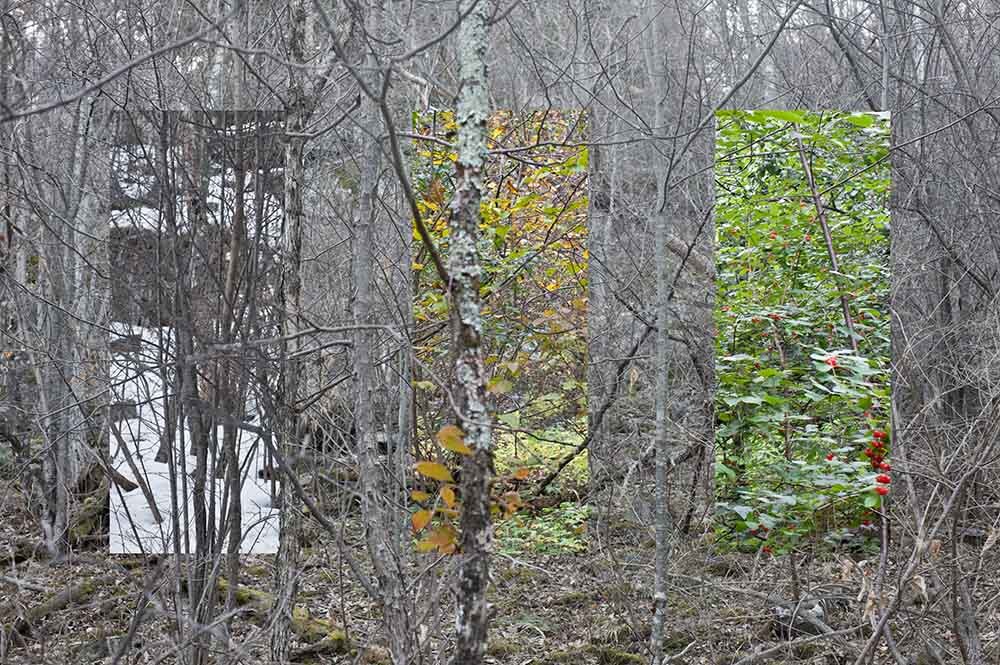
After many years I still find the forest's seasonal changes startling. These dynamic transformations are integrated in the "time composite" photomontages. Past, present and future coexist in a time cycle incarnate. These photographs attempt to materialize that notion of past and future existing in the present moment in the present form. Our fascination with photography is grounded in such accords: the unity of time - the photograph presents a moment of the past right now; the unity of space - the photograph places all its contents onto the same surface and into relationship; the unity of time and space - the photograph shows that these elements are not separate. The time composites are embodiments of change arising from the Brutalist instinct of throwing things together, the Hadron Collider impulse. I have worked on variations of this change-in-the-landscape theme for over twenty years. I think this current approach finally works because both the continuity and the change are immediately evident.
The landscapes of the time composites were carefully photographed from the exact same location at different times. Being one view the time composites feel very close to being "straight" photographs to me. At first I marked the camera position with a stake using a plumb bob suspended from the tripod. A set of exact tripod measurements and ribbon guides placed in the landscape at the sides of the view would complete the initial set. This method worked but it took at least an hour, sometimes two, to reset the tripod and camera precisely. Very frustrating. After suffering a heart attack during one particularly exasperating reset (see plate # 000 - the last image in the maquette), I changed my procedure. I now attach a camera mount to a tree, or I leave a tripod in place, weighted down with bricks, for a full year. These time composites, and all the other images in the book, have not been digitally manipulated. Computer tools have been used to piece together the different digital negatives made on different dates but nothing else has been created or altered.
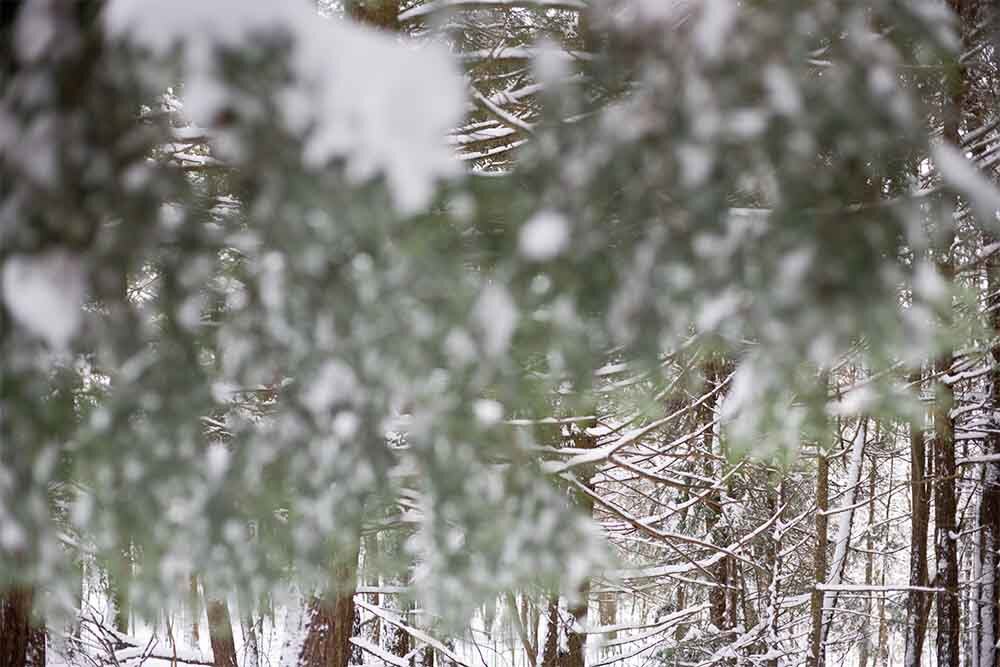
Our conceptions of time and seasonal change may be challenged by the specificities of the year-long chronology of straight, single-exposure photographs (the second section of plates). Ideas of spring and autumn especially, are often simplistic. Vermont will give these preconceptions a good shake. The northern locale combined with the mountainous terrain produces quite variable weather. The elevations of the pictures vary by as much as 1500 feet, which can effect a two-week difference in conditions. All the photographs were taken over the course of eight years.
Image List
Time Composites
1. Otter Creek West Bank, View West: Summer/Autumn; 8 September 2008/13 December 2008
2. Dead Creek, View East: Summer/Autumn/Winter; 15 September 2008/15 October 2008/26 February 2009
3. Snake Mountain North, Thicket, View West: Summer/Autumn/Winter/Spring; 27 July 2008/13 October 2008/16 February 2009/28 March 2009
4. Snake Mountain North, View South: Summer/Autumn; 22 July 2008/7 December 2008
5. Snake Mountain North, View Southeast: Spring/Winter; 16 June 2010/29 December 2009
6. Near the Arnold Bridge over Otter Creek, View East: Spring/Spring/Winter; 17 April 2011/18 May 2011/101221 December 2010
7. Buck Mountain, View East: Summer/Autumn/Winter/Spring; 27 August 2008/15 October 2008/4 March 2009/14 April 2009
8. Snake Mountain North, Upslope, View West: Spring/Spring/Spring/Autumn/Autumn; 11 April 2011, 14 May 2011, 26 May 2011, 18 October 2010, 9 December 2010
9. Snake Mountain North near Logging Road, View Southeast: Spring/Winter; 3 May 2010/25 December 2009
10. Snake Mountain North, Under Ridge (North), View West: Spring/Spring; 16 April 2011, 17 May 2011
11. Snake Mountain North Above Waterfall, View West: Spring/Spring/Autumn/
Autumn; 11 April 2011/27 May 2011/11 November 2010/9 December 2010
12. Snake Mountain, Extreme North, View North: Spring/Autumn; 14 May 2011/2 December 2010
13. Snake Mountain North, East Trail, View North: Spring/Autumn/ Autumn; 14 May 2011/6 November 2010/15 December 2010
14. Otter Creek, View North: Spring/Summer/Autumn/Autumn/Winter; 23 March 2011, 31 August 2011, 21 November 2011, 19 December 2010, 5 March 2011
15. Snake Mountain North, Downslope, View Southeast: Spring/Autumn; 2 May 2010, 6 December 2009
Spring, Summer, Autumn, Winter
16. April 5
17. April 16
18. April 25
19. May 26
20. June 8
21. July 29
22. August 25
23. September 19
24. September 30
25. October 6
26. October 8
27. October 13
28. November 5
29. December 2
30. December 8
31. December 17
32. February 6
33. March 16
34. Snow Forms Grid
35. Tree Trunks Panorama